Do we act like Christians?

Homily for 26th Sunday in Ordinary Time Year B
Readings; NM 11:25-29 , JAS 5:1-6 , MK 9:38-43, 45, 47-48

I went to what at the time was one of the largest High schools in Connecticut. We were so large that we could only fit 3 grades in the high school. Of course, there were groups of people that stuck together. We had the jocks, the cheerleaders, the antagonists and there was the one fraternity. I did not belong to any one of these groups. Like many of my classmates, I would talk with and move between the groups as some of my friends and acquaintances were among them.

There was also a group of folks who believed in sexist and racist ways. I did not mix well with this group of people. When I came across them in the hallways the only reason for us to interact was if we had a class assignment we were working on together. We still managed to work together in these situations without our outlook on life as we knew it.

What I learned most from all of this, even when I was working with people whose philosophy on life was different from mine, was that we can still work together to complete an assignment or project. These groups often interacted in extracurricular activities at the school. Many from the different groups would be together on an athletic team or act together in the school plays.

I have heard from teenagers and from my own children that there is not as much of us vs. them mentality in high school anymore and there are fewer groups to navigate your way through. Of course, what I did hear was there was not the same level of interaction among groups that disagree with each other.

I had the opportunity to see how my school with all its groups that disliked each other handled a tense situation. We had a race riot in the school when I was a sophomore. The riot was so bad they closed the school down at, and we were sent home. I rode on a bus which consisted of 98% African Americans. Most of these folks I knew from growing up in the neighborhood. I chose to ride a different bus home from school that day.

The school was closed the next day to allow things to cool off. When we were to return from school, I had the opportunity to walk a half block to my regular bus or in the opposite direction two blocks to get on a different bus. I as a typical high schooler chose the less strenuous option, the half block walk. When I got on the bus, I was at the last stop, I realized I was the only person on the bus who was Caucasian including the bus driver. I sat in a seat toward the front of the bus, and there was talk amongst some of the guys on the bus how bad they would beat me up on the ride to school. Then one young man stood up and said to those on the bus, that I normally rode this bus, I grew up with many of these guys, and I had never once shown anger toward them.

Now I do not tell you this story today to try and make it sound like I was such a wonderful young man, because I did harbor my own suspicions about some of their actions just because of their race. What I do tell you this story for is because we have devolved into a society where once you are labeled in a specific group you are labeled that way forever. These labels and groups end up doing more harm than good as we see in today’s society.

We hear in today’s readings two discussions about people who were outside the fold still doing things that the inner circle thought was only for them. Joshua complained to Moses that some men were prophesying when they were not on the camp where the 70 received the Holy Spirit. Moses asks Joshua if he was jealous for his sake.

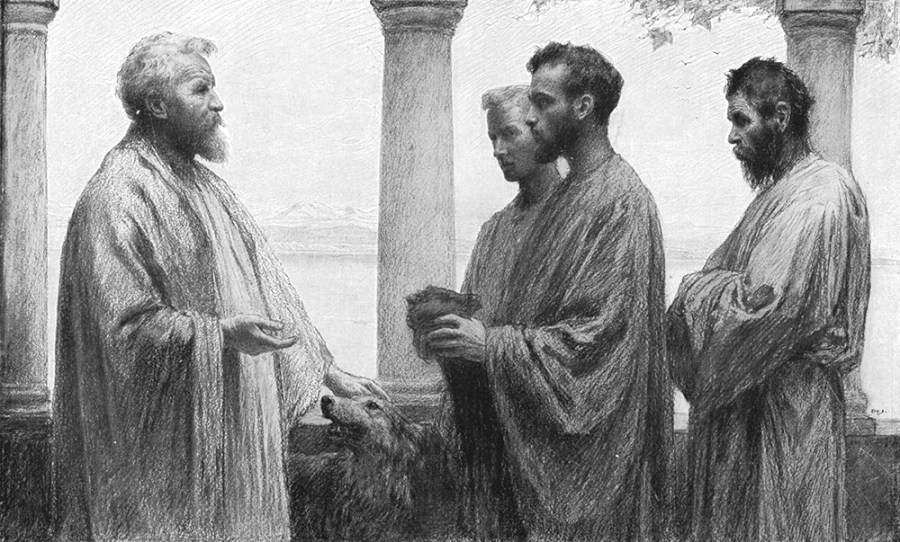
In the Gospel reading, we hear the disciples complaining to Jesus that there are others outside their group that is driving out demons in Jesus’ name. Jesus plainly says that they should not stop them and reminds them that whoever is not against us is for us.

These readings stand to remind us that just because we are inside these walls on Sunday, we are not the only ones who can be called Christians. Jesus goes on to warn the disciples that whoever causes harm to the little ones who believe should indeed begin to change their ways. There are many Christians, Catholic Christians as well that do an excellent job of reminding everyone that they are Christian and then proceed to do very un-Christian like things.

There are also many people who do not make a big deal out of the fact that they are a Christian but certainly prove it by their actions. These can come from defending and assisting those less fortunate, not spreading gossip or in any other way acting immorally.

We hear claims that we are being persecuted as Christians in today’s society, but do we act like a Christian? We hear James remind us what happens when we hoard our treasures or talents from others. He also tells us that we have all been guilty of condemning others when there was no sign of their guilt. By our actions, we may actually take away the faith of a person by how we act. This can be seen in many different aspects of our world today.

This played out in the political arena this week with the reputation destroying rhetoric coming from both sides of the political spectrum. Depending on your side would depend on whether you tried to ruin the reputation of the accused or the accuser.

We see it in the church with the most recent scandals that have erupted in the church. We have lost believers because some of those who lead the faithful acted and continued to work in anything but a Christian manner.

So what can we who stay in the church and participate in politics do? We can begin by reminding ourselves that we will not be the final judges of anyone here in this life. We may think we have that right, but we were not endowed with that ability.

We can also remember that just because we disagree with someone, it does not give us the right to belittle them. As I said at the beginning of this homily I mentioned that I grew up with a high school that could be separated into specific groups. We still managed to work together for the common good.

Do we need to chop off our hand, or gouge our eye out to overcome these faults which are found in each and every person on this planet? No, we can keep from leading people astray by prayerfully and compassionately reminding them of what Jesus taught. We can also lead them to the truths that are found in Christianity by living our faith the way in which we are taught.

When we lead by example in word and deed, we can accomplish great things. I learned valuable lessons in high school when I was forced to interact and work with people that I strongly disagreed with. The lessons I learned helped me in my life and the experience gained in doing these things showed me there are right ways and wrong ways in which to lead your life. How we lead our lives and interact with those, we disagree with, or those who have done horrific things goes a long way to show the world what a Christian currently is. Do we all show the right example?

How Open are We

Homily for 23rd Sunday in Ordinary Time Year B
Readings; IS 35:4-7AJAS 2:1-5MK 7:31-37

When I was younger, I was reminded on many occasions to clean out my ears so that I could hear what I was being told. This was usually said when I either ignored something or made like I did not understand.  I have even been accused of not listening to my wife. As my children grew up, I realized what my parents and wife were talking about as my children seem to be situationally hard of hearing.

I am sure there are people here who know fellow parishioners who are going through difficult times, but they seem to be some of the happiest folks we know. They are listening to and living God’s word. When we live as if this life is not the end but a step to eternal life, we realize being open to the word of the One who promises eternal life is a good idea. The best example of this I remember seeing was a young lady who was making her first communion. She was in the end stages of fighting brain cancer, a fight she eventually lost, but during her time here she showed us all the unbridled joy that can come with being open to God’s call. She happened to pass away in the early morning hours on the day of my ordination. I was made aware of this not long before the ordination Mass was to begin. The one thing I remembered was the Joy she exuded on receiving the Eucharist the first time.

In the gospel today Jesus meets a man who is deaf and also has an impediment in his speech. It is his friends who bring him to Jesus. We note the sensitivity of Jesus. He takes the man apart from the others, in order to cure him. We see the gentleness of Jesus in dealing with the man in a very personal and caring way. He doesn’t want to embarrass him or treat him as a case. He treats him like another human being in need of respect and gentleness because of his situation.

How many of us have been in a position to do the same but were situationally hard of hearing? When we were baptized whether it was as infants or as adults one piece of the Gospel is repeated. Ephphatha is a word that means be opened. In the baptism right as our ears are touched we are told “The Lord has made the deaf hear and the dumb speak. May He soon touch your ears to receive His word, and your mouth to proclaim His faith, to the praise and glory of God the Father. Amen.”

When we are open to this we can be part of what we hear in the first reading;

Be strong, fear not! Here is your God, he comes with vindication;
with divine recompense, he comes to save you.
Then will the eyes of the blind be opened,
the ears of the deaf be cleared;
then will the lame leap like a stag,
then the tongue of the mute will sing.

Now you definitely do not want to hear me sing a solo, but the idea is when we live for God, as He calls us to, we need to be open and honest with ourselves as well as others. This is something we cannot do if we are not open to listening to others. By listening to others we can learn things not only about ourselves, but where we may not be open.

As James reminds us today when we treat people differently because of their dress, appearance, financial situation, or their employment, then we are not living to do God’s word. We are supposed to treat all with equal dignity and respect, even when we disagree with them. This is a crucial piece of the puzzle. When we listen to others with respect, we have the ability to learn the reasoning behind their thinking. While we may still disagree with them, we will not need to attack them because we now have an understanding of why they could think this way.

When we listen to God’s word and proclaim his word, we show the world a better way to live. Today in society we hear such a destructive message. We are to work hard and make as much money as possible so we can spend it on things that allow us to be happy because we have more stuff. We try to keep up with our neighbors, all the time becoming more tired, stressed out and less connected.

Less connected is probably not something you would think we have in today’s world. We have instant access to as much information as we want. The so-called social media platforms are making us less social. We see people at restaurants sitting with each other, and both spend the entire time engrossed not in conversation with each other, but in their “smartphones.”

Now I am not saying that all these inventions and information are a bad thing. How we utilize them is where we can get off track. We begin by starting to weed out voices we do not want to hear and only listen to those we agree with. We become closed to new ideas and viewpoints. This leads to us being more isolated, closed, just the opposite of Ephpatha.

We are called to be opened. This means open to helping those less fortunate than us. Open to learning from different perspectives and not closing ourselves from society but being an active participant.

Now, this openness needs to work both ways as well. We need to be open enough to share our trials and tribulations. This can lead to others learning from us what not to do. This could lead to some penance we need to endure, but in the end, we will be working toward our eternal reward.

When we are open to dealing with adversity openly and honestly, we can experience short-term pain, but in the long term gain our eternal reward. Individually we experience these things on a regular basis. How we deal with them, we can see how open we are to listening to God’s word.

We will be sharing in the Eucharist celebration shortly. Are we all being as open as the young lady was when we approach the altar? We can all be open to God’s word, and while we may not proclaim the Gospel out loud, we can do so by our actions. When we are open to the Joy that comes from listening to and living the Gospel, we will show this to others, and they may want what we have.


Why Should we Stay

Readings;  JOS 24:1-2A, 15-17, 18B,  EPH 5:21-32 OR 5:2A, 25-32,  JN 6:60-69

When I was younger, I was taught that if you did something wrong, it would be a lot easier on you if you confessed that sin upfront rather than someone finding out about it later. The church is currently going through one of those times where she has committed multiple wrongs on multiple levels. She needs to come clean and be open about it, so we can begin to heal.

Many people are proposing ways to accomplish this, and most of these folks are more qualified to offer their input and suggestions on the way to root out the evil that seems to have taken up residence with some clergy members. Just as we are asked to confess our sins, we are now in a position where the church needs to confess all its sins. Like our feeling of cleanness and relief, the church can avail itself of this same feeling.

We hear today the last installment of four in the Bread of Life discourse. Jesus reminds us that the words he speaks to us are Spirit and Life. He is telling those around him that he is genuinely sacrificing himself for the sins of the world. He does this so that we can be closer to God, not further away. While the thought of eating another’s flesh and drinking their blood is a teaching that is hard to fathom, much less participate in, we do so in every Eucharistic Celebration we attend. Jesus, through the priest, changes the bread and wine to his body and blood.

With this great mystery comes an interesting phenomenon where he can strengthen us from within allowing us to live as he would like to see us live. Not in a world of violence, subversion, corruption, and immorality, but a world where there are no labels, and nobody needs to hide because of their actions.

This strength helps us to serve God as we hear the tribes of Israel proclaim in the first reading. I received as a gift for my ordination a needlepoint piece with the line from the first reading.
“As for me and my household, we will serve the Lord.” There are many people within the church and outside the church who have forgotten this statement. Do we truly serve the Lord or are we giving this lip service and serving the Lord only when it suits us?

The pain and suffering that has been inflicted on countless people by the actions of the church, as Pope Francis reminds us, never goes away. The church is in a position now to accomplish something that can show the beacon of light in the darkness that it is supposed to be. The evil needs to be confronted head-on and dealt with. No more hiding behind the walls of the church but bring the evil into the light and expose it for all to see. When this is done, we can all begin to heal together.

The reading from St. Paul to the Ephesians has the famous line about the wife should be subordinate to the husband. It stirs up in many a visceral reaction to that statement. However, the husband is supposed to be as Christ is to the church allows this statement to have a deeper meaning. As the wife is compared to the church and the husband to Christ we are called to work together for a happy marriage.

When one or the other of this pair act in a way which makes trust difficult the only way to overcome this is to go back to what we learned as kids, it is better to be upfront about any sins, rather than waiting for the other to find out. When we work together in a marriage, we find that no problem is too large to solve. We understand that there is a covenant between husband and wife that allows both to be equal partners in the marriage with the Father. Well, at least that is how it is supposed to be.

The fact that there is a covenant entered into at the time of marriage and God has given us various covenants means that through Christ we are to work with him. This means that we all need to work together to root out the evil that invades our lives, our homes, and our church. When we work as a team, it will be difficult if not impossible for evil to win. As in a marriage when we look at solutions for a problem, we look at all the solutions available and pick the best strategy. Even if that strategy leads to additional pain, we do this to be rid of the problem.

This type of solution works in business as well because everyone knows what the end goal is and agrees to work together to attain that goal. When one does not hold up their end, they should be held accountable. This is much easier with oversight.

It can work the same within the church. While we are currently in a tough spot as a church, that could have been avoided, and we now have the opportunity to help the church recover and not be put in the same position again. How this will be accomplished is yet to be decided, but in my opinion, it should be something that is taken up across the entire church, not just in the US. Not just in the diocese where folks have known about it, but in every diocese within the world. This may lead to more disturbing revelations, but they will be out in the open where the evil will be confronted and defeated.

There are many good men in the presbyterate and the episcopate who would like this resolved so they can get back to the work of Christ. We are led by such a priest and bishop. Some have stated their thoughts on addressing this, and some members have come out and seemed tone deaf to what has happened. While it is easy to say these folks could care less, we should leave the church. The harder thing is to do what the Apostles did. As Peter speaks for the apostles when he says “Master, to whom shall we go? You have the words of eternal life.” I believe our church, a divine institution run by fallible men,  holds the truths that Jesus taught, and we should work to help her.

With a renewed focus on being a parish, diocese and worldwide church centered on upholding our end of the covenant entered into by Christ at the crucifixion, Christ will hold up his end we will not only survive but thrive as a church.

Building our Root System

Homily for the 11the week in Ordinary time Year B; EZ 17:22-24,  2 COR 5:6-10,  MK 4:26-34

First, I want to wish all the fathers a Happy Father’s Day. This includes fathers, grandfathers, stepfathers, adoptive fathers and our spiritual fathers.

I remember when my children were younger and smaller, they were easier to deal with. They believed everything you told them, and you were a king as far as they were concerned. Then they get to middle school and their teenage years. All of a sudden you become dumber than a rock. The funny thing is they really think that you cannot relate to their problems. While there be some circumstances we don’t understand due to the generation it is in, the significant issues are all still the same as when we were their age. There is the feeling of not fitting in, being bullied, or bullying someone else are among some of the most common. While today that can be exacerbated by social media, the issue is the same.

We hear in the Gospel today the story of the sowing of the seeds as well as the parable of the mustard seed. Parents of all stripes can relate to the part; “This is how it is with the kingdom of God; it is as if a man were to scatter seed on the land and would sleep and rise night and day and through it all the seed would sprout and grow, he knows not how.”

We were there when our children were conceived and born. Then one minute it seems like they are just learning to walk and the next they are leaving the house, whether for college or off to work a trade. Seemingly this happens of its own volition, of course, we help this along by feeding them.

This parable can also be related to our faith. We begin with an inkling of God and then through listening to his Word and watching the examples of others our faith can either grow or stagnate. It increases when we continue to feed it just as with children. In order to feed it, we need to listen to the Word of God, study it and be nourished by it coming to Mass on a regular basis. This will help us grow into mature faith-filled adults who can be examples to others.

In today’s society, it is easy to forget this as we are called to multi-task, or there is a screen that has a show, or a game playing that we cannot resist. That screen will tend to lead us further from God, and this is what allows our faith to stagnate, I understand this from personal experience. It can be overcome if we go back and listen, study and participate in God’s Word.

The mustard seed parable goes along with this and enhances this. Like a small seed, our faith begins. Then when we nourish and water the faith, it can become one of the main focuses of our lives which is a good thing. This grown and mature faith is there to help us create a safe haven for those we love. You can see this in the idea that we hear in both the reading from Ezekiel as well as the Gospel where they talk about a safe place for the birds to sit in the shade.

In Ezekiel, we are told that from this faith of Israel, the kingdom of David, God will send forth and nurture a king. This is related by the phrase “I, too, will take from the crest of the cedar, from its topmost branches tear off a tender shoot, and plant it on a high and lofty mountain; on the mountain heights of Israel, I will plant it.”

The reading goes on to say it will sprout many branches, the church, and all its teachings. This will then give protection to the people who call the church home. With this protection from the hot rays of the sun, we are expected to bear fruit and watch out for the least among us. The least among us takes us back to our children whom we have been given temporary custody of here in this life.

We as fathers have a unique role in the raising of our children. As Paul reminds the Corinthians, we walk by faith, not by sight as we are in our earthly bodies. Of course, as we age our bodies can begin to wither and become frail as these are only temporary vessels here on earth for our spirit to live in. We all should be looking not for what we can gain in this life, but what we need to do in this life to achieve eternal life with God.

As fathers we are to be courageous, which does not mean we show no emotion. It says that in raising our children and taking care of our spouse, we know that we do not walk alone. The spirit is with us as we do this. It is certainly easier said than done, especially with teenagers in the house.

As we celebrate Father’s Day with our families, let us remember that Christ was human just like we are and when we walk by faith he will be with us always. We would like to think that we have the internal strength to do this on our own. However, those with experience will remind you that it is a lot easier to handle the stresses that come along with children if we invite God along with us for the journey.

Men like to think of themselves as the big tree or bush described in the readings today, and there is nothing wrong with that. The tree and bush only stand upright and withstand the wind and the elements with a healthy root system. We need to be rooted in our faith, strengthened by the Eucharist and continually ask God for the strength to shade those around us from the blazing sun that we see in society today. Fathers I ask you how healthy your root system is?


Gaudete Sunday

Readings IS 61:1-2A, 10-111 THES 5:16-24JN 1:6-8, 19-28

We are now in the third week of Advent, Gaudete Sunday. This Sunday is marked by rose vestments and the idea of rejoicing in the coming celebration.

This week we can look at where the angels are leading us. Isaiah reminds us the Lord has anointed us for the world. We are to be heralds to the poor, brokenhearted, and downtrodden of our neighborhoods. In doing this, we help to free ourselves from the challenges posed by the materialistic society that surrounds us.

We all fall prey to the materialistic nature of life that goes on around us. After all, we want to provide everything possible for our families to make their lives easier. This time of year, as we are preparing for Christmas is an especially tempting time to go overboard. We can decide that our family and friends need to be impressed by the amount of money spent on gifts. This decision can be based on a giving nature. When we try to take care of those around us just to impress we fail to lead the way to Christ. Doing this only perpetuates the materialistic culture that we live in. Luckily the church has given us a way to help guide us back to the path. That is in the sacrament of reconciliation.

We can feel isolated in the way we are taught by Christ to lead our lives. Christ taught a manner of living that was countercultural during his time as one of us. It is equally countercultural today. We can certainly feel like we hear John remind us today of what Isaiah had prophesied. He said, “I am the voice of one crying out in the desert, make straight the way of the Lord.”

We are called to be that voice crying out. While this may mean saying and doing things that go against the society we live in, it is necessary to help us on our path to salvation. In doing so, we also remember what St. Paul is telling the Thessalonians. “In all circumstances give thanks, for this is the will of God for you in Christ Jesus.”

This means while we are leading this Christ-centered life we need to be full of joy and rejoicing. We are not alone in this task, and we are led by God followed by his angels. We are not called to be frightened of angels, but to look to them for leading us along the path. Angels themselves serve God as we have already learned by comforting and providing hope to the afflicted. They help us see the glory of God and prepare the way for God to work.

So in doing this work, we are called by St. Paul today to “Rejoice always.” He also calls us to “pray without ceasing” These two concepts seem to be impossible on the surface. How can we always be rejoicing? We tend to let our circumstances in life determine our joy, some examples of circumstances that may rob us of joy.

We got stuck in a traffic jam.
The kids are driving you nuts. Work is getting crazy and stressing us out.

With all of those things happening it is impossible to rejoice always when we base it on our circumstances. The joy we read about in the scripture has nothing to do with circumstances. God’s will is you always have joy regardless of your circumstances. His joy is bigger than your circumstances and bigger than you. It is not a feeling or emotion it is a gift of the Holy Spirit.

When we let our circumstances dictate our joy we rob ourselves of the Joy that God wants for us. The only solution is prayer. We all need a strong prayer life, but we need to work at it. While a life of prayer without ceasing seems impossible, if we look at it in terms of gratitude and thanksgiving it becomes a little easier. We offer prayers for our circumstances so that we can be filled with Joy. When we determine this will work, and we work at it, we find it becomes what we worship.

So what are some common themes for worship in the society we live In? I would list money, power, pleasure, sports, the kids and I am sure you can think of others. When we worship these things, we find that we cannot be joyful in all situations. We find ourselves praying for just a little more of what we worship, but then we find out that this object we worship changes with the stress of the day.

When we change our lives, which is the point St. Paul is making we can begin authentic worship. When we begin to worship God, we begin to act like angels who worship God with their entire being. They will live in God’s presence and stay focused on him. Scripture describes angels as constantly worshiping and praising Him. In fact, one of the most solemn and sacred moments at Mass is taken from the prophet Isaiah’s description of angelic worship: at a great distance…

I saw the Lord seated on a throne, high and exalted,
and the train of his robe filled the temple.
Above him were angels, and they were calling out

“Holy, holy, holy is the Lord Almighty;
the whole earth is full of his glory.”
Isaiah 6.1-3

In today’s gospel reading we hear the familiar story that always accompanies our Advent celebration: the story of John the Baptist. The greatest and last of all the prophets John is a towering figure in the Gospels who helps us recognize and receive Christ. The Bible says

He came to testify to the light
so that all might believe through him.
He was not the light
But he came to testify to the light.
John 1.6-7

That’s what angels and saints, and ordinary everyday Christ-followers do; we’re not the light, he is, we testify to the light.

Our daily prayer time and our weekly worship at Mass are not meant to be the sum total of our worship. What is wanted is a change in lifestyle, a worshipful life, a life filled with worship.


​Do we use our Talents for God?

33rd Week in Ordinary Time
PRV 31:10-13, 19-20, 30-311 THES 5:1-6 ; MT 25:14-30


We hear a parable today that we are all familiar with, the story of the talents. In Jesus’ time a talent was a form of money that was worth approximately 75 pounds of silver. As you can see this is a fairly large sum per talent. We of course want to know how this corresponds to today’s world. We can continue to look at it from a monetary value, but I would like to examine it from a different perspective.


We are Christians are all called to love like Christ, to emulate him, therefore to show the world the Kingdom of Heaven here on earth. We have each been given specific talents from God in order to show this through. Our choir has been given the talent of music, something I need some work on. They utilize their talents in the Mass to bring us closer to God. There are others in the assembly who have also been given this talent.


There are many varying and different talents that God has bestowed on individuals and in doing so he expects us to utilize those talents to bring people closer to him. The worthy wife we hear about in Proverbs can certainly be relatable to those of us who are married. Gentleman I am sure you would agree that having the good wives we have has made it easier to lead our lives. They can help us see our talents and exercise them. We need to be willing to do the same for them, help them find their talent and exercise it.


Why should we use our talents? God has graced us with these talents and he would like us to utilize them to bring people closer to Him. We need to use them to help those around us see God, even in the worst of times. When we utilize our talents we see others begin to use their talents for the glory of God.


God has distributed the talents so that some have more than others. Those who have more talent are called to more profound life led for God. Our bishops and priests are a wonderful example of using their gifts for the Glory of God. They stand in front of us and proclaim the Kingdom of God by the example of their lives. Within their number you can see a wide variety of talents being used. There are those that are wonderful administrators, those that are seemingly more compassionate, those who help guide us along our path to the kingdom.


When we take their example and begin to see that living our lives for God, regardless of our talent, we can influence those around us. Depending on our talents that influence can be small or large. When we use our talent for personal gain, and not for God, we find that we influence few if any to find the kingdom.


What happens if we wait to use our talent? We will all be called home to God from this earthly life at some point. Paul reminds the Thessalonians that we do not know the time or hour that this time will come. Paul goes on to remind us that we are children of the light, not of the darkness. As children of the light our light is to be a beacon for those around us to follow.


Do we see this usage of talent being put forth in the country or the world today? There are some examples, but not many. We see this played out by our Pope on a regular basis, on a world stage. He reminds us as Jesus did that when we help the lowest of society, we are helping build the kingdom. We also see it locally here, at the House of Mercy in Williamsburg. Their ministry continues to grow and expand as they help the least among us. The people who work and volunteer there show a love for their fellow man in everything they do.


I personally see it as the Director of Cemeteries for the diocese in how those responsible for the burying of the dead interact with the families that they assist. There is a level of caring, compassion, and love not seen in many places in today’s society. Regardless of the situation they bring forth Christ’s light to those who need it the most.


The examples I have given are but a smattering of what can be accomplished when we use our talents for the glory of God and his kingdom. We all at different times in our lives have used what we know and are good at for the betterment of society. For some of us we do this only occasionally, for others they do this all the time. Jesus reminds us however that;


“For everyone who has, more will be given and he will grow rich; but from the one who has not, even what he has will be taken away”


We cannot lead our lives hiding what God has graced us with and expect our reward in heaven. We need to use what we have been graced with in order to build up the kingdom. We also heard from Matthew “Nor do they light a lamp and then put it under a bushel basket; it is set on a lampstand, where it gives light to all in the house” When we utilize our gifts to help our fellow man we are lighting the way for them to follow.


With the talent that is represented within this parish we can see what can be accomplished when we use our abilities to help those around us. St. Bede does many things to help the greater community by utilizing the talents of the members of the parish. We see this carried out in our support for the House of Mercy, in what the Knights of Columbus accomplish in helping those around us. Many of the people who help in this manner remain hidden from view. They do not do the things they do for their own personal glory, but for the Glory of God.


I have had the opportunity to listen to people talk about their loved ones and how they used these gifts while here on earth. Most times these stories are ones of love, compassion and caring, sometimes they have not been so complimentary. How we use our gifts will be remembered, by those we leave behind as well as by our Father. With the strength we receive from the Eucharist we hope to be remembered in a positive way so that when we leave this life we can hear the words “Well done my good and faithful servant.”


The Wedding Banquet

Readings; IS 25:6-10APHIL 4:12-14, 19-20MT 22:1-14

Now imagine you were invited to a party at a person’s home you have always dreamed about being invited to, then when you get there, you realize you are way under or over-dressed. You would stand out like a sore thumb. Would you go in or would you turn around and leave.


For those of you who watch sports on TV, you may have seen the ad that relates to this. The person comes dressed in a costume for what he was told would be a fantasy party. He missed the part of it being a fantasy draft party. Needless to say, he is certainly not dressed appropriately and decides he will leave rather than stay and feel embarrassed or be mocked.


Now let’s put this in perspective of the readings we hear today. In Isaiah, we hear about a party that the Lord will hold a feast on the mountain for all his faithful that will be held to destroy death forever and bring all the nations together. Who would not want to be invited to a party like this?


In the Gospel, Jesus tells a parable about a wedding feast being held by the king. All the invited guests are too busy to worry about showing up. He sends his servants out to remind them that he has set out a banquet that was fantastic. His servants were ignored or in some instances were mistreated and even killed. Then he decides he has this feast all prepared so instead of the entitled folks who turned their noses up at him he sent his servants out to invite all of the people of the area, regardless of their standing in the community.


The one apparent stipulation was that you come dressed appropriately for a wedding feast. Well, one guest ignored this aspect, and instead of leaving when he realized his mistake he thought he could sneak in and not be noticed so he would be able to enjoy the feast.


Jesus is reminding us of the prophets and how they were ignored, mistreated or killed by the Jewish people over time. He is also reminding us that His call is to all people not just the Jewish people of the time. With these things comes his message of loving all people, even our enemies. We are called to the banquet every time we come to Mass with the Eucharist.


The trick is are we dressed in our wedding garment or are we just dressed as we would be to go to the gym. As a reminder, this has nothing to do with the clothing we wear. For we can wear the most beautiful designers and newest fashion but at the same time not be following what Jesus has taught us we need to do.


In St. Paul’s letter to the Philippians he reminds us that he has learned how to live at both ends of the spectrum, whether he was wealthy or lived in poverty. He goes on to mention to us the most important thing we need to remember. “My God will fully supply whatever you need, in accord with his glorious riches in Christ Jesus.”


He is reminding the Philippians that the feast on the mountain to celebrate the end of death was fulfilled in Christ Jesus. All we need to do to take part in this is to live in accordance with Jesus’ teachings.


Do we do this all the time? I know I do not, but I strive every day to let go of the things of this world so I can concentrate on the things that Jesus wants me to concentrate on, there will always be times where we can feel like the world is against us. This is the most critical time to come dressed for the party.


When we dress ourselves in Christ and show those around us that he is alive in us, we will be working our way to making ourselves ready for the wedding banquet. Many people have shown me this way to live. My Grandfather was such a man, regardless of the situation he found himself in he would live as if the time was a blessing. This could have been when he was asleep in the gutter because he had so much to drink he could not make it home. This was also evident when he was doing well enough to retire early and tour the country with my grandmother multiple times.


The interesting thing about it was that my grandfather was not a person who went to church on a regular basis, but he positively exuded the Love of Christ in how he dealt with everyone around him. He would remind us grandkids that our faith in God was important, and it was certainly essential to come to church, but it was equally important to live as God wanted each of us to live.


How many of us fail during the week to live as Christ teaches? My grandfather would offer his advice as the idea we should live what we believed. Not just on Sunday, but every day of the week as well. This is what the prophets tried to tell the Jewish people, and it was what Jesus was reminding the chief priests and elders of the people. Of course, we remember that these folks were treated pretty poorly.


We can all be guilty of treating those who are trying to help guide us on this path poorly at times. The question we need to continually remind ourselves is that being a Christian is not a part-time thing. It is a full time, 24/7/365 thing. We see the results that have been sewn by the evil one. It has led to divisions along political, social, economic, race and gender lines. With all these divisions it is easier to take a side, rather than try to reach across the divisions to bring people together, not tear them apart.


The line in the hymn “They know we are Christians by our love” goes a long way to explaining some of what we hear today. While showing our love does not mean we need to allow those around us to do whatever they want. It means that just as the King finally did, we invite everyone to be part of our party. We for our part cannot come to the party dressed improperly, so we need to put on Christ.


There is nothing that says life will be comfortable, or profitable, but we are told if we dress ourselves appropriately we will avoid the wailing and grinding of teeth that those who don’t come properly dressed to the banquet. How will you come dressed to the banquet?


We are called to Live our Faith

We are all called to have faith, but faith in what. When I was a much younger person, we were coming home from Black Rock State Park in Connecticut. My mother was driving and little did we know my mother was somewhat directionally challenged. We left the park after a fun day with family, and as we meandered home, my mother was heading in the direction she thought was correct on Rt 8. We were going for a while, and we saw a sign for Hartford. My brother and I were wondering why it said Hartford and not New Haven. Mom’s response was New Haven always comes before Hartford. Of course, that would be correct if you were coming from somewhere that was already south of New Haven, which Black Rock was not. So we continued to go, wondering why it seemed to take so long when we got to Hartford. Then mom realized where she was and jumped on the Parkway. She began to run low on gas, and we found a gas station. Mom only had a couple of dollars to put in the tank, which back then was good for about 4 gallons.

We finally made it home, 0and this is one of those stories that gets told from time to time around the family gatherings. We as children had faith that mom knew where she was going at the time, of course in hindsight we maybe should have been a little concerned. This faith we had in mom was based on nothing more than mom had always taken care of us and she would this time as well.

Jeremiah is in a similar situation today as he begins to voice the concerns for the Israeli people since they were moving away from God. He knew there would be people who would want him hurt or worse for what he was saying. As we hear “But the Lord is with me, like a mighty champion: my persecutors will stumble, they will be put to utter shame, to lasting, unforgettable confusion.”

The entire reading reminds of the world we live in today. “Terror on every side! Denounce! Let us denounce him!” We see terror play out all over the world, from London to Brussels, to Alexandria. People cannot get along, and all they want to do is denounce each other because they do not like what they are being told. The Jewish people continued on the path and were scattered and destroyed because of it. We are called to have faith.

We need to listen to those speaking the truth in the world not denouncing them. The sound of reason and logic needs to come back. The ones who speak it will be put down and denounced because those who want to continue on the path of emotion don’t want to hear reason. The world is currently being led down a path of emotion that may not end well if we do not have faith. The big question remains faith in what. Mathews Gospel today reminds us of the one we are to have faith in and whose word we are to proclaim.

We are given two options. One we can acknowledge Christ, and he will acknowledge us to the father. Two we can deny him, and he will deny us to the father. Those two options lead to two different places. One living in heaven with Christ and the Father. The other in a not so pleasant placed called Hell, where we have heard there will be wailing and gnashing of teeth. Personally, I would rather be with Christ.

What is it that makes those of us with a faith different? One thing that makes us different is we believe in a heaven where life will be much more pleasant. We also believe that if we live by Christs’ guidelines, we will be happier and those around us will be happier.

Another thing that makes us different is we acknowledge our weaknesses, most of the time. When pride and ego take over, we end up with a situation where we believe ourselves to be God. When we get to that point, we lose faith in him and have only faith in ourselves. This leads to the type of thinking that says if it feels good, do it. It also leads to the thought that since we are all different, we do not have the right to tell others how to live. We are not to judge them for their choices. This has led us to where we are today where even those who are supposed to be intelligent, eloquent people cannot listen to another before denouncing them simply because they come from a different viewpoint than them. If every individual is the only judge of what is good for them, we ignore the impact that has on the rest of society.

We are reminded again by St. Paul that sin came into the world by the actions of one man. But we are to be hopeful because by the actions of another our transgressions have been paid for. Faith and hope are two powerful motivators in life. When we have faith in what Christ teaches we can hope for a better world than we live in today.

Jesus reminds however that what we hear whispered we are to proclaim from the housetops. We are called to not be afraid of proclaiming the truth. If we proclaim the truth and do it from a perspective of doing it for Christ death will have no hold on us. If we proclaim what we determine is the truth we fall prey to those who can harm not only our body but our soul as well. We are all called to proclaim the truth, not just bishops and priests, each one of us who are baptized. The only way to know we are proclaiming the truth is to listen for God’s call. Proclaiming the truth does not mean we need to stand with a sign on the corner saying the end is near. We don’t even need to speak it; we need to live it. If more of us Christians lived a life worthy of Christ the world would be a better place.

So need to have faith and live our faith, even when it goes against the common culture of the day. Christianity has not survived for 2000 years because the teachings of Christ were the popular ones but because they were the right ones. So let us live our whole faith, not just those parts that are popular in our circle of friends.

Listening to the Holy Spirit

Sixth Sunday of Easter; Readings  ACTS 8:5-8, 14-171 PT 3:15-18JN 14:15-21


I knew a young man who loved his church and continued to go to Mass every Sunday after his confirmation. I worked with him, and I played softball on the same team as him for many years. He was a good friend while I was in Connecticut. I have lost touch with him over the years as I have moved around the country.


This young man always made sure he went to Mass on Sunday, and if we had a game Sunday morning, he would go on Saturday evening. He even missed a game or two because he went to Mass. His teammates knew this, yet we would still occasionally give him a hard time about it. He would just shrug his shoulders and tell all of us that he believed in Christ and this was his way of making sure he showed it.


With this example in front of me, a person who was not nearly as consistent, I saw in him a peace that was hard to understand. I would ask him about it from time to time, but was never satisfied with the answer, “Knowing Christ and feeling his Spirit within me keeps me peaceful.”


The Holy Spirit is a powerful ally in this life. When we are troubled, the Spirit can be there to remind us that we are not alone. We hear today some stories about the Spirit, who is the third person of the Holy Trinity.

images

The Spirit is called down on those who are confirmed, and Bishops are the ordinary clergy who do this. Philip in the reading from Acts is obviously not a Bishop as he called the disciples down to confirm the people he had baptized. Phillip, however, had this same peace my friend showed which when the people of Samaria heard him speak and witnessed his demeanor, they were ready to receive Christ and his message.


This message of hope and peace is brought out again with the letter from St. Peter. We are called to be able to explain our reason for hope even if we are derided for our actions. This hope comes from knowing we are following Christ and he has died so that we may live. This is one of the main points we are to take away from the Easter season.


This message of hope, peace, love and respect which Jesus teaches should live on in each and every one of us. When we begin to lose hope we can regain it fairly simply, sit and listen to the Lord. While it may be simple, it is certainly not easy in today’s world. During the time of Jesus and the disciples, there were fewer distractions than there are today. For that matter when I was young there were a lot fewer distractions than there are today. I know some of the young people don’t want to hear this, but there was no such thing as a personal computer, a cell phone, the internet or any of the other modern conveniences that allow almost instantaneous satisfaction. I was even privileged enough to have not had cable available to have 200 channels to choose from and still nothing to watch on TV, one tidbit, I did not even have a TV in my house until I was around 8 or 9 years old, and then I was the remote and antenna adjustor.


We could find time to be quiet and still with little to no noise to interfere with our thoughts. This did not stop me however from ignoring the voice of God for many years. The Spirit was always there. I simply chose to ignore it. In the quiet when it would begin to make its way to the forefront of my mind, I would find something to distract me, and not always good things.


Jesus calls us to follow his commandments in the Gospel reading today. He knew even his disciples would need help so he told them he would send them an Advocate, the Spirit of Truth for them to lean on when following his teaching. We all have access to that same Spirit today. Later this week some of our young people will receive the sacrament of confirmation, where the Bishop will ask the Holy Spirit to come and dwell within them. I hope and pray that they listen to the words and follow the commandments, but if they stumble, they should know that the Spirit will always be there. I also want to remind all of us that confirmation is not the end of our learning about our faith, but just the beginning for us to want to continue learning. Like everything else in life our faith only grows and deepens as we learn more about why we believe what we do.

images

As you may have figured out by now, I finally started to listen to the Holy Spirit within me, of course, this took another beautiful example to emulate. When I finally sat still and began to listen there were many things which scared the daylights out of me. God was asking me to stretch myself, even though I felt unworthy, in ways that I thought meant only for the “goody two shoes” among us. As I soon found out, He is more than willing to wait until you are ready to hear what he wants to say.


This lesson of hope and peace is something that needs to be shown more and more in our world. We need to get back to having the capability of civil discussions about our differences so that we can come to understand. We are all individuals who are influenced by those around us, some good, some bad.


I have been lucky enough to have been influenced by many good people over the years, including my friend, who I had always admired because of his conviction and hope. The Holy Spirit will always be there for us, even when we choose to ignore it or wish it would simply go away. If we listen to it, we will know the Truth that following his commandments is actually easy, even though it is counter-cultural.


Of course, in order to listen to the Spirit, we need to be able to hear it. While it is difficult today it is not impossible, we can all find ways to silence our minds and heart. We just need to be willing to do so. While I dreaded the silent retreat I was required to do before ordination, I was able to find that peace and hope we all long for. I continue to look for those opportunities to find a peaceful calming place to listen and see if it is time for me to receive an answer to my prayers. This, however, does not occur if we expect the answer instantaneously. All answers come in His time, not ours, but we need to be ready to receive them as well.